Showing posts with label apricots. Show all posts

Wednesday, January 15, 2020

Apricot season


The apricots I've bought this year seem to be particularly good.  But nice as they are eaten fresh, the full flavour comes out best when they're cooked.
So far I've used them in two different recipes. One is Apricot Suédoise, a superbly simple dessert that tastes purely of apricot. You can see how to make it here.

The other is even simpler - roasted whole apricots. Here's the recipe.

Small apricots roasted whole

12 small rosy apricots
200 g runny honey
1 Tbsp brown sugar
Juice of ½ or 1 smallish lemon
100 ml water
1 tsp cinnamon
whipped cream and/or yoghurt, to serve

Preheat the oven to 170ºC fan forced (180C without fan).

Place the honey, sugar, lemon, water and cinnamon in a small saucepan. Cook on a medium heat, stirring, until it comes to a boil. Turn down to a simmer for 3 minutes and remove from the heat.

Place apricots into a small ceramic or glass baking dish. You want them to be sitting neatly together without too much extra space around them.

Using a sieve (to filter out the cinnamon), pour over the honey liquid.
Gently turn the apricots over in the liquid to coat them.

Put in the oven and roast for 10 minutes, then take out the dish and spoon the liquid over them again.
Put them back in the oven for another 10 minutes approximately. Remove them when they are cooked through, but not collapsing - you want them to stay whole.

Carefully take out apricots one by one with a spoon and transfer to serving dish or small individual dishes. (I made small dessert servings by putting three apricots in each of four pink glass Arcoroc teacups, with a dessert biscuit in each saucer.) 

Pour liquid back into small saucepan and gently reduce to form a syrup. Pour syrup over fruit and leave to cool. 

Serve with either whipped cream, or yoghurt, or a mixture of both (this is very nice). If you want to, you can flavour the cream with a dash of orange liqueur. Remember to warn your diners that there's a stone in each one.

I forgot to take a picture! Sorry. Here's one of the cups I used, only with an incredibly easy to make chocolate cream in it. You'll have to imagine it with apricots. Come to think of it, apricots and chocolate have a marvellous affinity, so you could try a shallow layer of this chocolate cream with apricots on top...


Friday, January 17, 2014

Simple apricot galette

I'm something of a heretic when it comes to apricots. Unless they come perfectly ripe to the hand from the tree, I think these gorgeous glowing globes taste better when they're cooked. Cooking seems to bring out that wonderful contrasting sharp/sweet flavour.
    We managed to bring some apricots back from Central Otago, and I wanted to use them for dessert to serve a visitor from Britain. I remembered that the friend I consider to be the finest private cook I know uses a recipe that involves sprinkling ground almonds on a round of pastry, putting the cut fruit on top and folding in the overhang to make a rough tart or galette. So I went hunting online and came up with a recipe from Alice Waters. I could have made the pastry myself, using her recipe or one from Dean Brettschneider, but I didn't have time, so I bought sweet short pastry instead.
     I also adapted the almond mixture that goes on the pastry first - Waters had more flour. The point of this mixture isn't just to add the almond flavour, which goes so well with apricots, it's to absorb the juice from the fruit so there's no soggy bottom. As the pictures show, this really is quite a "rough" tart - that's part of its charm.

Apricot galette (Adapted from Alice Waters, Chez Panisse Fruit, Harpercollins)
Serves 4

Enough home-made or bought short sweet pastry to make a circle roughly the size of a medium dinner plate
2 Tbsps ground almonds
1 tsp plain flour
1 Tbsp plus 1/4 cup plus 1 Tbsp white sugar
6 - 8 ripe apricots (depending on size - they should not be the very biggest ones, and small ones are fine. It doesn't matter if they're just a little soft, but they shouldn't be really hard.)
1/2 Tbsp unsalted butter, melted
Apricot jam (optional)
To serve: cream, icecream or yoghurt (optional)

Preheat oven to 200C. (If using a fan oven, set it to 190C, fan bake.)
Roll out the dough to a circle about 35cm across. It's a good idea to do this on a piece of baking paper large enough to fit the oven tray you are using. Put the pastry on the paper in the fridge and chill for at least 15 minutes.
Mix the ground almonds, flour, and 1 Tbsp of the sugar together.
Cut the apricots in half and remove the stones..
Remove the prerolled pastry on the paper from the fridge, and place carefully on the oven tray.
Very gently mark out a circle on it, leaving a border at least 5cm wide all round. (Don't cut into the pastry.)
Sprinkle the almond mixture evenly over the circle.


Arrange the fruit, skin-side-down, in concentric circles on the dough, making a single layer of snugly touching pieces, leaving the border bare. Sprinkle 1/4 cup of sugar evenly over the fruit.
While rotating the tart, fold the border of exposed pastry up and over the fruit to enclose it snugly round the edges. Make sure there are no breaks in the pastry so that no juice can leak out.


Brush the folded-over border with the melted butter, and sprinkle it with the last 1 Tbsp of sugar.Bake in the lower third of the oven for about 30 minutes, until the crust is well browned and its edges are crisp and slightly caramelized.
As soon as the galette is out of the oven, slide it on its paper onto a cooling rack, to keep it from getting soggy. Let cool for 15 minutes.
If you want to glaze the tart, brush the fruit lightly with a little warmed apricot jam. Serve warm, with a little whipped cream, vanilla ice cream or yoghurt if you like.


I didn't glaze mine (actually, I forgot) but I don't think it's necessary - the apricots look so beautiful on their own, with tiny brown bits around the edges. This is a slightly lurid photo - it was dark by the time I took it - but you get the idea. As you can see, I left it a little too long in the oven so it got a bit dark around the edges, but it really didn't matter - those crunchy bits tasted great.

Thursday, March 8, 2012

Nothing but apricots

For lunch with friends on Saturday, I wanted a light dessert to follow the antipasti, beef and cheese. I can't remember when I first made apricot suedoise, but it must have been close to twenty years ago. I found it in my ancient paperback of Cordon Bleu Desserts and Puddings, by Rosemary Hume and Muriel Downes, published in 1975 [not 1875 as I mistakenly typed when I posted this!]. It's an invaluable source of classic recipes, and you can still buy the Penguin paperback online.

What I like about this recipe, apart from being able to make it a day in advance, is that the ingredients are so simple - basically just apricots, plus sugar, gelatine and a little lemon juice. I used big firm Otago apricots - they would have been even better if they'd been just a little riper, but because you cook them, it doesn't really matter. The only variation from the original recipe is that I leave out the almonds that are meant to go in the poached fruit halves - they look pretty, but I don't think their hard little intrusion is a good idea. I've also translated the measurements into metric.


Apricot Suedoise (there should be an acute accent over the e, but that's hard to do on my computer)
~ Halve and remove stones from 1 kg fresh apricots.
~ Make a sugar syrup by boiling 350ml water with 170g sugar and a strip of lemon peel in a medium saucepan. Remove the peel.
~ Cook the fruit in two batches. Choose the eight best halves and place them rounded side down, cut side up in the syrup. Bring it slowly back to a very gentle boil and cook until tender, but still retaining their shape.
~ Lift these halves out carefully with a slotted spoon and place them (I prefer rounded side down, but it's up to you) evenly round the bottom of a metal ring tin.


~ Cook the rest of the fruit until very tender. Cool a little and reduce fruit and syrup to a puree in either a food processor or a blender.
~ Extract the juice from 1/2 a large lemon or a whole small lemon. Put it in a small metal bowl and make it up to 5 tablespoons with water. Soak 2 tablespoons of powdered gelatine in this mixture. Hold the bowl over simmering water and stir to dissolve the gelatine. Stir it thoroughly into the puree (I just whizz it all up again briefly).


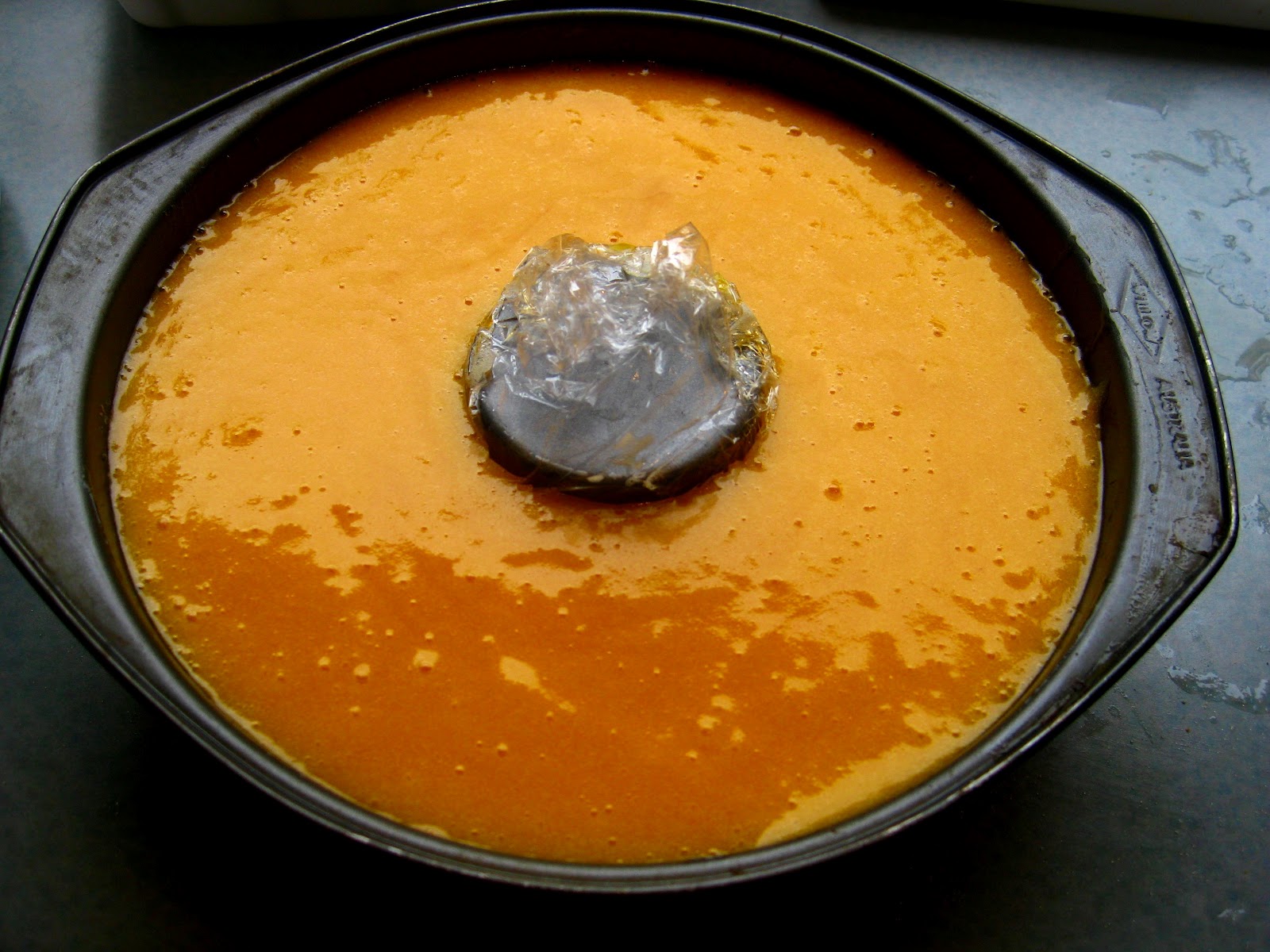
~ Pour the puree into a glass jug (if you've used a processor) and leave it to cool. When it looks as if it's starting to set, pour it carefully over the apricot halves to almost fill the ring tin. (I tried putting clingwrap round the centre bit first, so it would come out more easily - it sort of worked.)


~Cover with clingwrap and leave to set in the fridge. (You could probably get away with making this in the early morning, but it's easier to do it the day, or night, before.)
~ Take it out of the fridge about an hour before you want to serve it. Just before serving, twirl the tin carefully in a sink of hot water, then put a big plate over it and upend it. With a bit of tapping on the base, it should come out cleanly.


If you like, you can fill the space in the middle with something - cream, yoghurt, chopped fresh apricots (maybe soaked in brandy and sugar for a bit), strawberries, even flowers. Or not.  (Mine is filled with the bit of clingwrap, which I forgot to take out before I took the photo.) The main point is the incredibly intense apricot flavour of the suedoise, which I think is perfect all by itself.