Showing posts with label pasta. Show all posts

Thursday, September 22, 2016

A new take on pasta with meatballs

This week I had an out-of-town friend coming to visit. The plan was to head into town for afternoon coffee and cake, go to see The Rehearsal at Lighthouse Cuba, then come back home for dinner. I wanted to make something I could at least partly prepare in advance, so that we could get home about 6.30, sit down for a while in a civilised fashion with a glass of wine and a snack, then move smoothly on to dinner without me having to faff around for too long in the kitchen.
       One solution was the slow cooker, but we've had quite a few slow cooker meals lately. I settled on Claudia Roden's Basilicata meatballs, served with Lois Daish's "sauceless" pasta with herbs and caramelised onions, and a pretty beetroot and red cabbage salad (I threw in some barberries as well). I could do the meatballs and onions and prepare the herbs ahead of time, along with the guacamole for starters. Then all I needed to do in the evening was cook the pasta, make the salad and warm up the meatballs and onions. It all worked very nicely.
        I thought I'd already posted the meatball recipe on this blog, but I hadn't; so here it is, along with Lois's very simple but delicious pasta.

Polpettine fritte
(Very slightly adapted from Claudia Roden, The Food of Italy)

500 g minced pork
4 tablespoons fresh white breadcrumbs
1 tomato, peeled and chopped, or 1 dessertspoon tomato paste
4 tablespoons grated parmesan if possible, grate it from a piece, don't use the ready-grated stuff)
1/2 a mild onion
salt and pepper
2 tablespoons raisins, coarsely chopped
2 tablespoons pinenuts, toasted lightly in a dry frypan
olive oil for frying

Set oven to low (to keep meatballs warm as they cook).
Put the meat, breadcrumbs, tomato, and cheese into the food processor. Grate in the onion and season with salt and pepper. Pulse till well mixed. (OR work everything together well in a bowl.)
Mix in the raisins and pine nuts by hand.
With damp hands, shape into small balls (it makes about 24).
Heat oil in frypan and cook meatballs on medium-low heat with space between them (you will need 2 or 3 batches depending on the size of your pan), pressing down a little on each one, then turning when they are browned and cooking the other side.
As each batch cooks, put meatballs on an oven tray lined with paper towel and keep them warm in the oven.  (I heated them up like this for dinner, replacing the paper towel with baking paper.)

Fettucine with caramelised onions and herbs
(From Lois Daish, Dinner at Home)

The original recipe is for 1, this one is for 4.

4 medium or 3 large onions
2-3 tablespoons good olive oil
fettuccine or other ribbon pasta (Lois says fresh, but I used the very good dried Italian kind that comes in tidy little bundles of about 70g - one bundle is enough for me, but you might want more)
4 tablespoons finely chopped winter herbs, such as sage, thyme and/or rosemary
2 medium cloves garlic, crushed to a paste
At least 4 tablespoons grated parmesan (Lois says this is optional, but I don't think so!)

Slice the onions finely lengthwise (I did mine using the slicing blade in the food processor).
Heat the olive oil in a frying pan and cook the onion over a moderate until it starts to colour.
Reduce the heat and cook for 20-30 minutes, stirring gently every so often, until the onion is soft and dark golden brown. This can be made well ahead and stored in the fridge.
Put a large pot of water on to boil. When it's boiling, stir in salt and then add the pasta. Stir lightly with a fork and boil for 4 minutes if fresh, 7-8 minutes if dried.
While it cooks, place a metal bowl either over the pasta or over a second smaller pot of boiling water (I didn't have one to fit the big pasta pot). Add the onion (plus a little more olive oil if it's a little dry), the herbs and the garlic. (I don't like raw garlic, so I fried mine with the onion.)
When the pasta is cooked, drain it thoroughly and tip it into the bowl of onion mixture (or if that one isn't big enough, transfer pasta and onion mixture to another warmed bowl).Toss with a fork so that each strand of pasta is lightly coated with oil.
Stir in parmesan (with extra on the side for serving) and season to taste.

If you're having the meatballs too, pile these into their own warm serving bowl, along with a simple salad. Have warmed individual bowls or pasta plates ready.


I got a good photo of the pasta (pappardelle), though the onions don't show up very well, they're lurking underneath. But the meatballs came out all blurry - blame it on too much red wine (in me, not in the meatballs).

Thursday, May 29, 2014

Doing things to oysters

I see that I haven't put a post up since 1 May - shocking. No real excuses at all, simply a fit of winter slothfulness and avoiding coming up here to the main computer (which is much easier to write on than my iPad) because it's warmer downstairs.
        But this long gap doesn't mean I haven't been cooking - quite the opposite. What I tend to do quite often these days is get an idea, look up several different recipes related to it, then pick and choose bits of them and assemble my own version to suit the ingredients I have on hand, the amount of effort I want to put in and my own judgement about what will work best.
        Earlier this month I had a (not very significant) birthday. There have been a series of delightful lunches and other outings with friends, with at least one more to come. But generally the evenings have been spent at home, sometimes cooking for friends. On my actual birthday, though, I was home alone, so I made the most of it.
         Harvey loved oysters, and so do I. But he wanted to eat them in only two forms: completely au naturel, with lemon, pepper and thin bread and butter, or battered and deep fried. (Sent up the road to get a parcel of fish and chips for dinner, he was very good at turning it  into something much more sexy by throwing in a dozen oysters.) So when I saw a $10.95 oyster special at Countdown, I decided I would break out and do something different with them.
          The pottle turned out to contain six very large oysters. I ate two all by themselves as a starter, then set about turning the rest into a sauce for pasta. I looked at half a dozen recipes and came up with my own super-simple version.

Pasta with oysters for one
(Just size it up for more servings - hungry people may well eat 100g of pasta each. The quantities for the wine and cream are only approximate, since it depends on the amount of oyster liquor, the size of the oysters, and how oystery you want it to taste.)

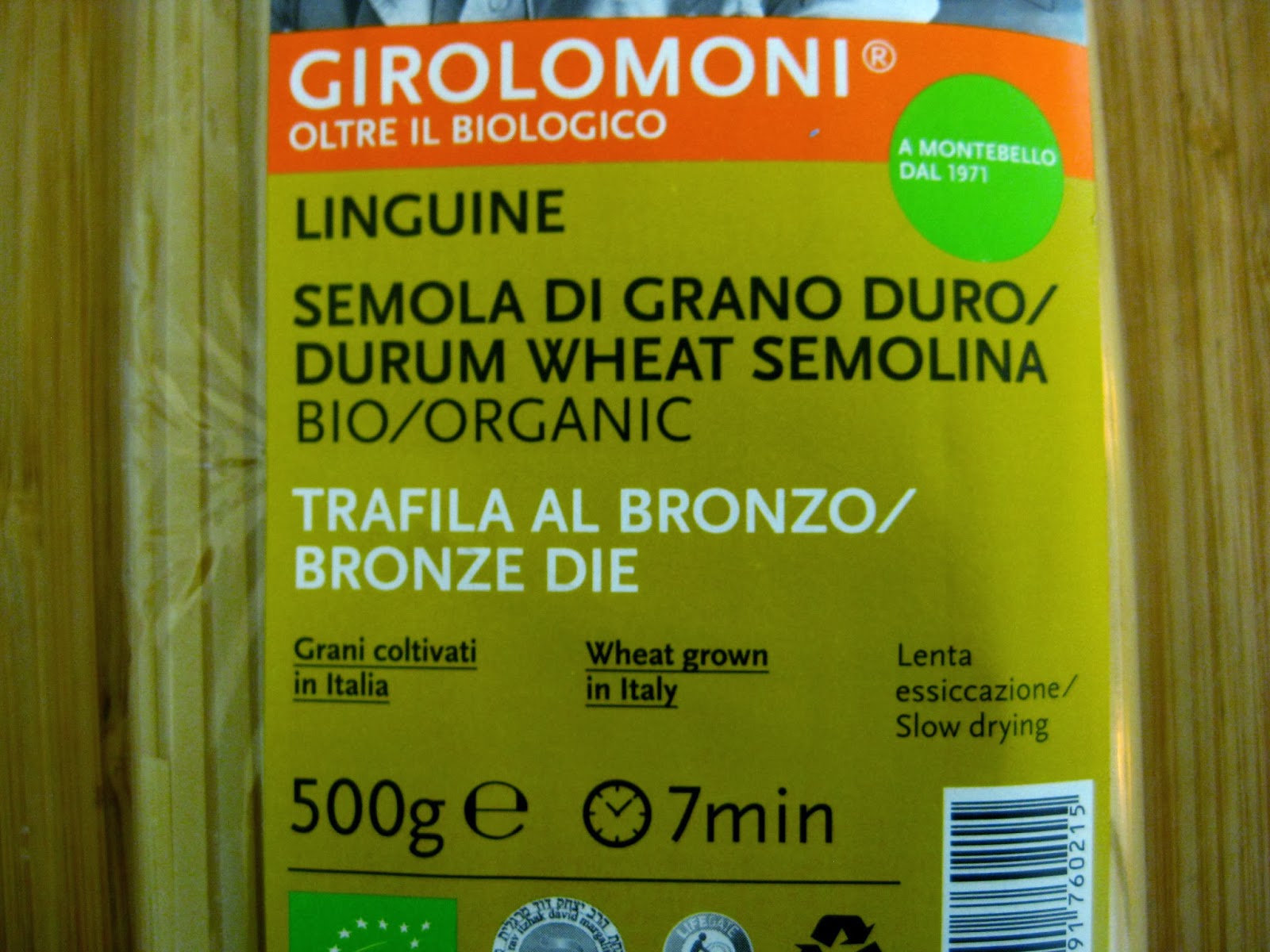
75g linguine, preferably bronze die cut (see here)
tender white and green parts of one small leek, chopped into fine rings
20-30g butter
2 small rashers streaky bacon, cut into small pieces
4 large or 6 smaller oysters, with their liquor
approx. 250ml dry vermouth or dry white wine (I prefer vermouth)
juice from half a small lemon
freshly ground black pepper
75ml cream (or more to taste - if you like a blander sauce, use more cream)

Cook the pasta in a large pan of boiling salted water. When it is al dente, remove 2 tablespoons of the cooking liquid and reserve. Drain the pasta, return to pan, stir in a small piece of the butter, and keep warm.
In a shallow non-stick pan, gently cook the bacon pieces in their own fat, remove, and set aside.
Melt the butter and gently saute the leeks. Remove and set aside with the bacon.
Drain the oyster liquor into the pan and add the vermouth or wine and the lemon juice. Bring to the boil, turn down to a simmer and put in the oysters, cut into pieces if they are large ones. Poach the oysters for 2 minutes, remove and set aside.
Warm a wide shallow pasta plate.
Increase the heat under the pan, add the 2 Tbsp saved pasta water, and boil gently until the liquid is reduced to about 1/2 cm in depth in the pan.
Turn the heat down to low. Put in the bacon, leeks and oysters. Stir in the cream and heat gently through. Check seasoning.
Put pasta in plate and pour over the sauce. Grind more pepper on top to taste.
Eat immediately with a glass of your favourite dry white. (Gruner veltliner is my favourite with oysters, but there are plenty of other good choices.)


This is one of the fastest dinner dishes I've ever cooked - and one of the most utterly delicious. I ate it making small appreciative noises to myself, and telling Harvey's photo that there were indeed more than two good ways to eat oysters.

Thursday, February 13, 2014

A tasty bronzed Italian

When it comes to food, you really do learn something every day. I wandered into Gamboni's Deli this week in search of some linguine, the nicely flattened pasta that I find much easier to manage than standard spaghetti. Most of the time I buy Barilla in the supermarket, but I go to Tony Gamboni for anything a little out of the ordinary.
           There were two packets of linguine. One was $4.95, the other was $6.95. That's quite a big percentage difference - but on the other hand, it's still not a large amount of money, especially as I don't have other hungry people to feed every day and a 500g packet makes me around six or seven dinners. 
           

So I asked Tony why they were different prices. He showed me that the more expensive packet said "bronze die".


The big commercial pasta companies, he said, extrude their pasta from machines using Teflon dies. This works really well, because nothing sticks to the Teflon. But that's the problem. The pasta comes out perfectly smooth. Using a bronze die gives it a slightly rough surface - as you can see in this photo. And that, of course, means the sauce sticks to the pasta much better. Magnifico.


So of course I bought it - who could resist a tasty bronzed Italian? I had a vacuum-sealed packet of New Zealand clams in the fridge. Like the mussels, they're cooked and come with their juice, so it doesn't take long to:
- get the pasta into boiling salted water for 7 minutes, then drain, keeping a couple of spoons of the water for the sauce and warming a pasta plate with the rest
- take the clams out of their opened shells (keeping a few in their shells to go in the sauce - it looks pretty but it also seems to add a bit of flavour)
 - soften some garlic and onion, reduce a bit of white wine or dry vermouth, add some thyme leaves, the clam liquid and 2 Tbsp pasta water
- reduce all that a bit, add the clams and taste for seasoning, adding a spoonful of cream if you feel really decadent
- tip the sauce over the pasta and mix it carefully
- chop some parsley and quarter a lemon
- serve strewn with parsley and with a hunk of bread, a wedge of lemon and a glass of white wine on the side.


Saturday, December 14, 2013

The afterlife of a smoked chicken

I love smoked chicken, but I tend to buy it only when I want to feed other people. Last weekend our book group had its Christmas pot-luck lunch, and smoked chicken came into my mind. A big salad, I thought, with my garden lettuce, beans, asparagus, red pepper, mango and smoked chicken, with mayonnaise on the side. Lovely colours, lovely flavours. And lo! It appeared - and was quickly devoured.
      But even though there were eight of us, and a smoked chicken looks quite small, I had enough chicken left over for my dinner that night and I still hadn't eaten it all. So the next day I pulled all the remaining flesh off the bones and cooked up the carcass with an onion, parsley and some juniper berries to make a delicious smoky flavoured stock. I left it in the fridge overnight, then transformed it into a spaghetti sauce for a quick dinner.
        It was very good, but a little too liquid. I had deliberately cooked extra spaghetti, so I put the leftover portion into the sauce, still in its pot, and put the whole thing in the fridge.
         Next night I got it out for a second dinner. The pasta seemed to have absorbed most of the sauce. I heated it up in the microwave and it was absolutely superb.

Smoked chicken and mushroom sauce for pasta

For the stock
1 smoked chicken carcass
1 onion
Parsley sprigs or one large stalk with leaves (preferably flat-leaved)
6 juniper berries
1 chicken stock cube
Bring 3 cups water to boil. Add chicken carcass, quartered onion, juniper berries and parsley. Boil gently for about 30 minutes. Watch it and if the liquid is getting low, add more boiling water. Check seasoning. Strain off stock and leave in fridge overnight. Skim off fat.

Spaghetti or fettucine
Required amount for 2-3 servings
(I find 75g is enough for one serving, but you may want more)
Cook in boiling salted water till al dente. Drain and keep warm in the hot pan while you make the sauce.

For the sauce
(Enough for 2-3 servings)
20g butter
20g plain flour
50ml dry white wine
200-250ml stock
Juice of half a lemon
4 button mushrooms, thinly sliced
About 200g leftover smoked chicken, cut into small pieces if necessary
Melt butter in small heavy based pan. Off the heat, stir in flour rapidly to avoid lumps. Cook over gentle heat for 2 minutes, storing constantly. Off the heat, stir in half the stock. If you can be bothered, heat the wine to reduce it a little then add to sauce. (I must admit, I just put it in - the sky didn't fall and it tasted fine.) Return to gentle heat and stir until it thickens. Add the lemon juice, the thinly sliced mushrooms and a little more stock and cook, stirring, until the mushrooms soften a little and it reaches the thickness you want. (If you would like to try the  overnight pasta method, it should be quite runny.)
    Stir in the leftover chicken and heat it through. Check seasoning. You probably won't need more salt as the smoked chicken is quite salty, but you can grind in some black or white pepper if you like.


You can eat the sauce over the pasta immediately, or you can try keeping the sauce quite thin, putting the cooked pasta in it and keeping it till the next night, then reheating it. Magnifico.

Thursday, July 26, 2012

In praise of pasta

My friends Ali and Lynn have joint July birthdays, so we always get together to do something special. This year we made pasta. Lynn had done a course at La Bella Italia, so she was our guide, and Ali provided the pasta machine.   It was one of the best cooking and eating days I've ever had.
               The basic pasta dough recipe is here, together with the two ravioli fillings we used (Lynn had made these in advance): ricotta with spinach, and pumpkin with parmesan.

Egg pasta dough (La Bella Italia)

2 cups of “00” flour (Lynn was told she could also use high grade flour - we did, and it was fine)
½ cup of durum wheat fine semolina flour (grana dura)
4 medium eggs
2 more eggs, well beaten, to brush the dough with

(The olives and bread were to nibble while we worked.)
Thoroughly sift together flour, semolina flour, and a pinch of salt. On a clean surface, make a mountain out of the flour mixture and make a deep well in the centre. Break the eggs into the well. (In Italian this is called the nest, for obvious reasons.)

Whisk eggs very gently with a fork, gradually incorporating flour from the sides of the well. When mixture becomes too thick to mix with a fork, begin kneading with your hands.

 Dust dough and work surface with semolina as needed to keep dough from becoming sticky. Knead dough until it is smooth and supple (this took us at least 15 minutes). Wrap dough tightly in cling wrap and allow it to rest at room temperature for 30 minutes.


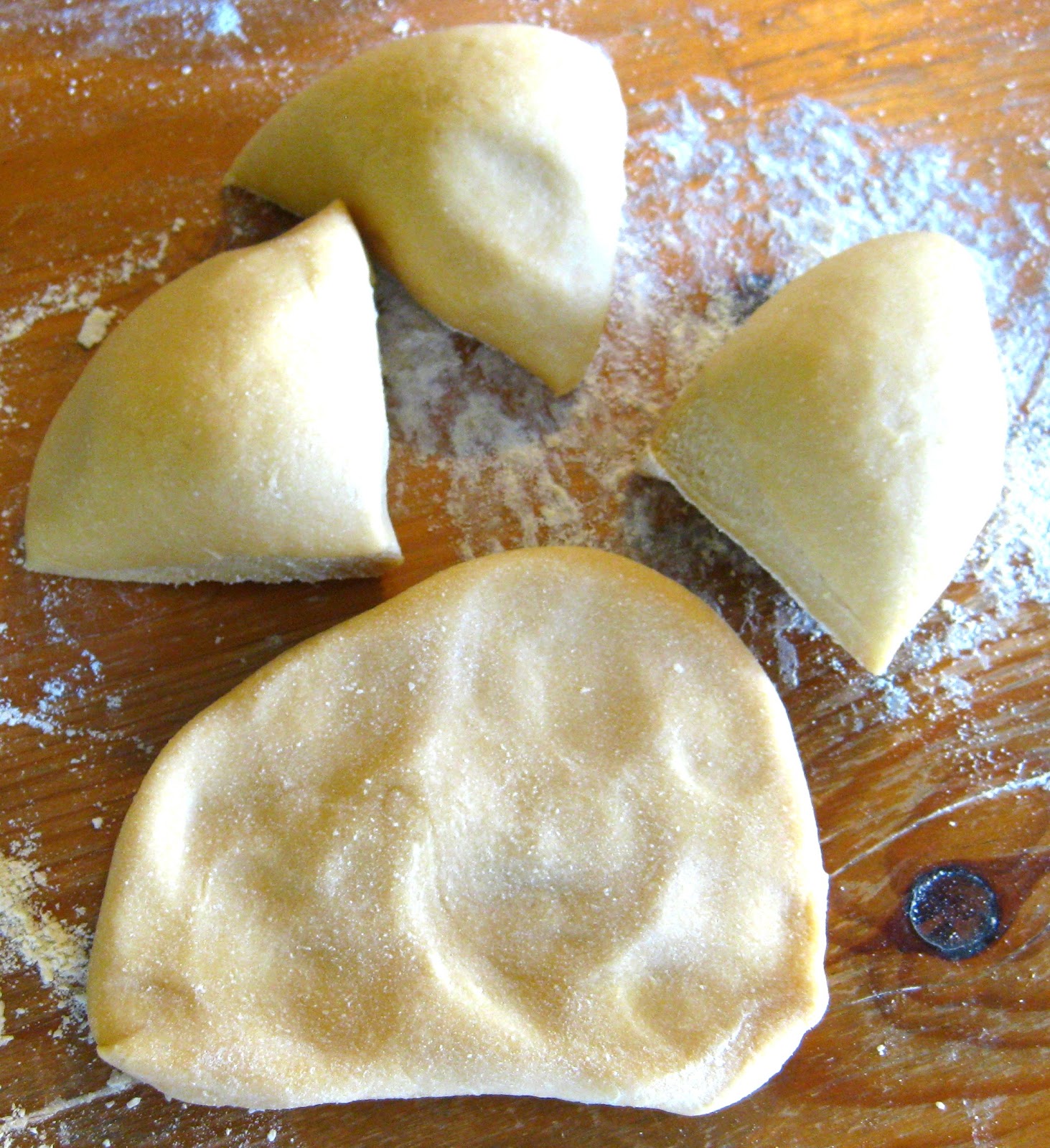
And here it is, just as it should be, after all three of us took turns at kneading - the amazing gluten-busting transformation has taken place.


Next comes the fun part (which isn't described on the recipe site). Set up the pasta machine - what a gorgeous piece of machinery! It should be clamped to the table, but if you can't do this (we couldn't, as the table edge was the wrong shape), one of you will have to hold it down (this is why it works much better to have at least two people). 


Divide the dough into four pieces. Take one piece and flatten it out a bit. Feed it through the machine on the thickest (first) setting, then double it over and put it through several times more.


Keep raising the setting and feeding the pasta strip through so that it gets thinner and thinner. You will end up with an immensely long strip of almost translucent dough. 
        Lay this out on the bench or table (over a light dusting of semolina flour) and brush it with beaten egg.


Put a big pot of water on to boil. Arrange spoonfuls of filling along half the strip. Fold the other half over and press down around each spoonful.


Lynn had a little shot glass that was just the right size to define each spoonful neatly - the idea is to get out as much air as possible. 


Then we cut each one into a square and cooked them in the water for a few minutes until they were done, draining them carefully in a colander.


Next week I'll write about the whole Long Italian Lunch we had, with antipasto, the two kinds of ravioli as the star turn, and a recipe for the tiramisu we had for dessert.  
         We made the fourth piece of dough into fettucine, and I got to take it home. It took three minutes to cook, and I had it with the simplest possible sauce of good olive oil, garlic and herbs.


Friday, April 1, 2011

Cooking in the Catlins

Here I am on the perfect picnic log, at what used to be called Moa Bone Point, on the Papatowai estuary in the Catlins. Walking along the beach, you can see where the sea has eaten into the bank and exposed the layers of ash from the moa hunters' hangi. If you're lucky you might even see a moa bone sticking out (though of course you won't remove it - all such finds are protected).
      We picnicked most days, very simply - bread and butter, salami, cheese, fruit - but not till 2 pm or even 3. No rushing, that's the essence of a good holiday. We were lucky - we left Dunedin on a Saturday, so we were able to stock up first at the railway station farmers' market.

Breakfast was fancy organic muesli and fruit, including the rhubarb from the cottage garden cooked up with the wonderfully tart red apples Jenn salvaged from a roadside tree. You can't buy proper cooking apples like these any more. (Apparently everyone has the right to pick fruit from roadside trees growing outside fences or hanging over them - it's called fructage.)

After coffee and one small piece of toast with comb honey, we set off for wherever Jenn had planned. She grew up in the area so I couldn't have had a better guide. By lunchtime, after what seemed to me like a really virtuous amount of walking - to beaches, waterfalls, rainforests - we were ready for morning tea. I'm happy to report that there was no shortage of good cafes. Owaka had giant slabs of carrot cake. Balclutha's indifferent coffee was offset by sensational home-made neenish tarts.  Gore had magnificent date scones and passionfruit yoyos, plus remarkable sculptured latte leaves. The only off-note was the eye-watering $24 we paid for two mochas and two afghans at McLean's Falls.


I had offered to take over the cooking, to give Jenn a break after doing all the driving. I really like working out what to make in holiday kitchens, and our Papatowai eco-cottage had all the basics. I think my piece de resistance was the Owaka Four Square's Bluff oysters, followed by a pretty pasta with (frozen) shrimp, broccoli and fresh pale green Italian courgettes (a present from Jenn's friends' Dunedin garden), and a sauce made from the oyster liquid, softened mild fresh onions (another garden gift), lime juice and white wine....


.... but the salad of Taylor's Gold pears, farmers' market goat's cheese, gifted Dunedin walnuts and rocket nicked from an absent local friend's garden was pretty good too....


... and our market plums and sweet little pinot noir grapes, plus a square or two of chocolate, did very well for dessert, priming us up nicely for the nightly Scrabble contest. Once (thanks to two blanks) I got all my letters down - but even so, I only just beat Jenn.


PS: The only cheese roll I had was awful.