I can't make these, of course, but I did get one photo of them being made in a shop in a relatively quiet old corner of Guangzhou. And I bought some frozen ones for my son's freezer and showed him how to cook them, giving him something else to have at home besides tuna pasta and takeaways. But I do understand - why cook when you can go out to eat so much delicious food so cheaply?
Thursday, February 28, 2013
China Teatime
It's always teatime in China. But my favourite version came in the afternoon, sometimes for a late lunch, sometimes just as a welcome chance to escape the city streets and sit down for a while. What I loved most were the beautiful hand-made dumplings....here's a selection. Palest pink-toned shrimp and delicately flavoured vegetable from the big teashop on the edge of the park with the lanterns...
...and pork with leeks and the customary dish of mild vinegar, made fresh to order for us as we sat on the lakeside verandah of the tranquil garden hidden from a traffic-packed crossroads by the Marriott Hotel.
I can't make these, of course, but I did get one photo of them being made in a shop in a relatively quiet old corner of Guangzhou. And I bought some frozen ones for my son's freezer and showed him how to cook them, giving him something else to have at home besides tuna pasta and takeaways. But I do understand - why cook when you can go out to eat so much delicious food so cheaply?
Thursday, January 31, 2013
The last of the cherries
Well, the last for me this year - they're still in the shops, but I won't buy any more because I'm off to China soon, leaving a friend to house-sit. I'm trying to work out how I can post from there, but it may not work...
When one of my visiting English friends admitted that he loved dessert, I looked at my half-full box of cherries and thought, "clafoutis". Clafoutis is basically a thick pancake-like batter poured over cherries and baked in the oven. You can use other fruit, but technically it's then not a clafoutis, but a flaugnarde (another lovely word).
Clafoutis comes from clafir, an Occitan word meaning "to fill". Occitan isn't a French dialect, it's a very old separate Romance language which was once spoken and written across a large area, ranging from northern Spain up into southern France, centred on the Limousin, and part of Italy. Medieval troubadours sang in Occitan. But it was progressively suppressed by French rulers intent on imposing one language and identity. Today it's being enthusiastically revived, though it still has no official status in France (unlike Spain and Italy).
I haven't made one of these remarkably easy desserts for a long time, but I was pretty sure it was a simple recipe. And it is - but Mastering the Art of French Cooking, as usual, explains exactly how to get the best results.
Opinions differ about whether you should take out the cherry stones or pits. I think the clafoutis looks much better if you don't (besides being easier). Apparently the traditional version does leave the pits in, because they're said to release a wonderful flavour when cooked, whereas taking the pits out makes the taste milder.
Clafoutis
(from Julia Child et al., Mastering the Art of French Cooking (1961)
(This recipe worked perfectly in a 28cm square ceramic stovetop-to-oven dish.)
1 and 1/4 cups milk
1/3 cup white sugar
3 eggs
1 Tb vanilla extract
1/8 tsp salt
1/2 cup standard white flour, scooped and levelled
2-3 cups black cherries
another 1/3 cup sugar
icing sugar n a shaker for topping
a baking dish (metal or ceramic) which can go from the hob to the oven.
Preheat the oven to 180C (on bake, no fan).
Place all the ingredients except the cherries in a blender in the order listed. Cover and blend at top speed for 1 minute. (If you don't have a blender, work the eggs into the flour with a wooden spoon, then gradually beat in the liquids and other ingredients, and strain the batter through a sieve.)
Pour a 1/2 cm layer of batter into the dish. Set over a moderate heat for a minute or two until a film of batter has set in the bottom. Remove from heat and spread the cherries evenly over the thin layer of batter (which will hold them in place and stop them rolling around). Sprinkle over the second 1/3 cup of sugar.
Pour over the rest of the batter. Place in the middle of preheated oven and bake for about an hour (mine took a little less than this, about 45 minutes). The clafoutis is done when it has puffed and browned a little, and a thin knife or skewer stuck in the middle comes out clean.
It can be served hot or warm (I think it's better warm). It will sink down slightly as it cools. Shake icing sugar thinly over it just before serving (I forgot the icing sugar, but I'm not convinced it's absolutely necessary).We had a little creamy plain yoghurt with ours, or you can have cream, or just eat it on its own. This recipe is supposed to serve 6-8, but I'm afraid ours just nicely served four - tant pis.
When one of my visiting English friends admitted that he loved dessert, I looked at my half-full box of cherries and thought, "clafoutis". Clafoutis is basically a thick pancake-like batter poured over cherries and baked in the oven. You can use other fruit, but technically it's then not a clafoutis, but a flaugnarde (another lovely word).
Clafoutis comes from clafir, an Occitan word meaning "to fill". Occitan isn't a French dialect, it's a very old separate Romance language which was once spoken and written across a large area, ranging from northern Spain up into southern France, centred on the Limousin, and part of Italy. Medieval troubadours sang in Occitan. But it was progressively suppressed by French rulers intent on imposing one language and identity. Today it's being enthusiastically revived, though it still has no official status in France (unlike Spain and Italy).
I haven't made one of these remarkably easy desserts for a long time, but I was pretty sure it was a simple recipe. And it is - but Mastering the Art of French Cooking, as usual, explains exactly how to get the best results.
Opinions differ about whether you should take out the cherry stones or pits. I think the clafoutis looks much better if you don't (besides being easier). Apparently the traditional version does leave the pits in, because they're said to release a wonderful flavour when cooked, whereas taking the pits out makes the taste milder.
Clafoutis
(from Julia Child et al., Mastering the Art of French Cooking (1961)
(This recipe worked perfectly in a 28cm square ceramic stovetop-to-oven dish.)
1 and 1/4 cups milk
1/3 cup white sugar
3 eggs
1 Tb vanilla extract
1/8 tsp salt
1/2 cup standard white flour, scooped and levelled
2-3 cups black cherries
another 1/3 cup sugar
icing sugar n a shaker for topping
a baking dish (metal or ceramic) which can go from the hob to the oven.
Preheat the oven to 180C (on bake, no fan).
Place all the ingredients except the cherries in a blender in the order listed. Cover and blend at top speed for 1 minute. (If you don't have a blender, work the eggs into the flour with a wooden spoon, then gradually beat in the liquids and other ingredients, and strain the batter through a sieve.)
Pour a 1/2 cm layer of batter into the dish. Set over a moderate heat for a minute or two until a film of batter has set in the bottom. Remove from heat and spread the cherries evenly over the thin layer of batter (which will hold them in place and stop them rolling around). Sprinkle over the second 1/3 cup of sugar.
Pour over the rest of the batter. Place in the middle of preheated oven and bake for about an hour (mine took a little less than this, about 45 minutes). The clafoutis is done when it has puffed and browned a little, and a thin knife or skewer stuck in the middle comes out clean.
It can be served hot or warm (I think it's better warm). It will sink down slightly as it cools. Shake icing sugar thinly over it just before serving (I forgot the icing sugar, but I'm not convinced it's absolutely necessary).We had a little creamy plain yoghurt with ours, or you can have cream, or just eat it on its own. This recipe is supposed to serve 6-8, but I'm afraid ours just nicely served four - tant pis.
Monday, January 14, 2013
Gooseberry time
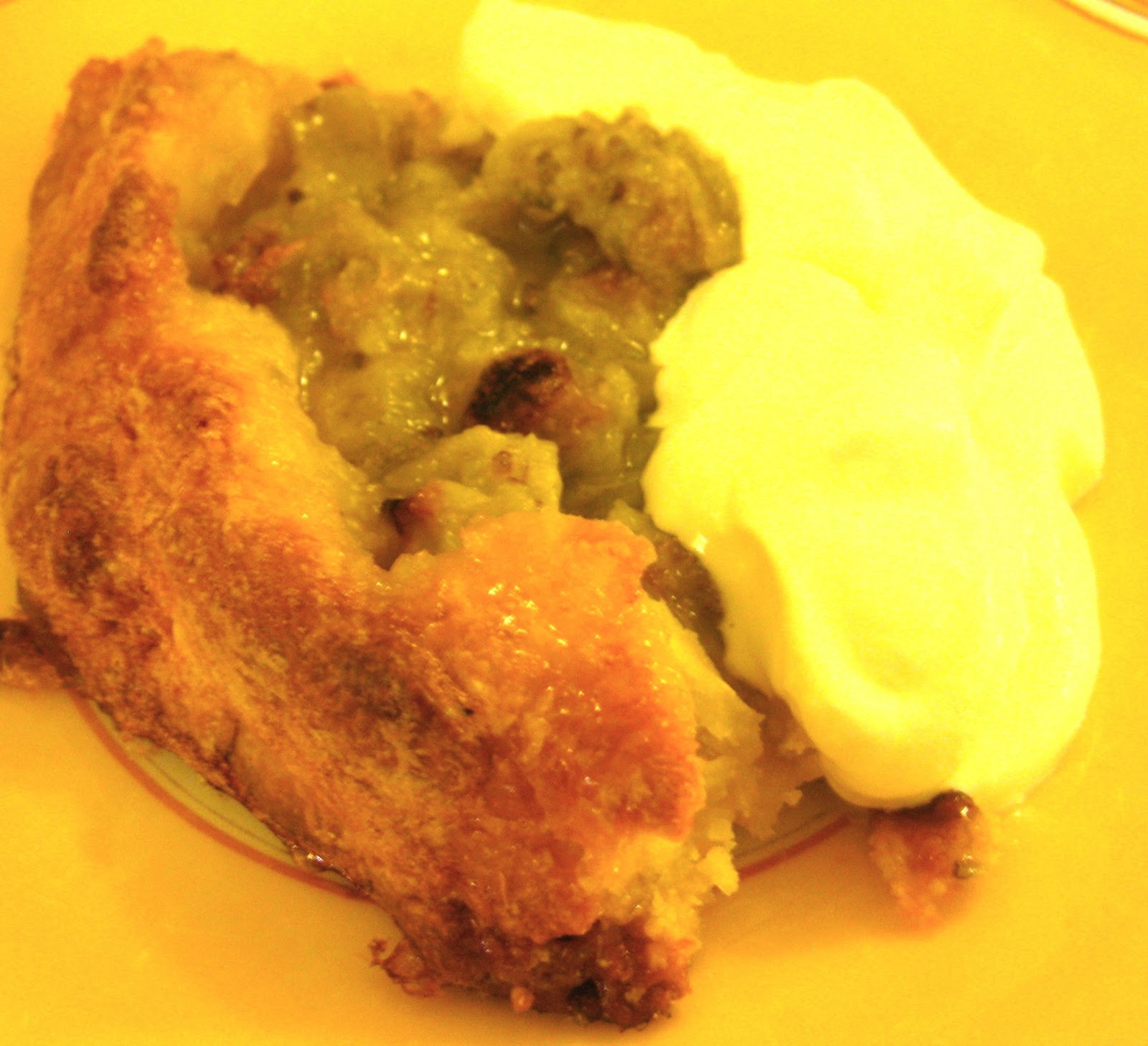
Harvey loved gooseberries - the greener the better, and not too much sugar. When he was ill he always asked whether they'd appeared in the shops. I was having two close friends for dinner last week, and I knew at least one of them (who grew up in England) loved gooseberries as much as Harvey did. There were only two punnets left at the greengrocer, so I carried them home and started hunting for a good recipe for gooseberry tart. They're a thoroughly English fruit - none of my French or American recipe books mention them. But a Guardian recipe by Hugh Fearnley-Whittingstall was exactly what I was looking for - except that he used strawberries as well, so I left those out. here's what he says about "goosegogs" (as they're known in some parts of England):
"Usually a soft, pale green, but sometimes golden,
or even tinged a gorgeous wine-red, these delicately bristled little fruits are
under-appreciated these days. I think this is because they require a little
work from the cook, beyond wash and gobble. But that is more than repaid by
what they give in return. Few summer fruits rival the goosegog when it comes to
complexity, depth and sheer zesty oomph. These characterful
berries have a long association with British cooking. Way back in the 1600s,
herbalist Nicholas Culpeper talked of them being scalded, baked or
eaten raw; there are recipes for them in Hannah Glasse's Art Of Cookery (1747), in Eliza Acton's Modern Cookery (1845) and Mrs Beeton's Book Of Household Management (1861). Gooseberry wine,
gooseberry sauce, gooseberry pudding, gooseberry jam and jelly: these simple
dishes are gifts from a time when richness of flavour was appreciated as
much as sweetness. That flavour is liberated by just the right amount of sugar;
always be ready to reach for a little more caster sugar if the cooked fruit is
coming up a bit tart…"
Here's my adaptation of his recipe for gooseberries alone – 300g green gooseberries leaves plenty of pastry to curl over the edge. For the pastry, I used the sweet short pastry recipe from Sebastien Lambert at Le Cordon Bleu school in Wellington.
Gooseberry tart
300g gooseberries
85g caster sugar, plus a little extra
to finish
Finely grated zest of 1 lemon
3 tbsp ground almonds
1 egg white, lightly beaten
Finely grated zest of 1 lemon
3 tbsp ground almonds
1 egg white, lightly beaten
Top and tail the gooseberries - cut off the tiny tip at the top and the little black remains of the flower on the tail - with a sharp small knife. Combine the berries, sugar and lemon zest in a glass or china bowl, and
set aside to macerate for 30 minutes.
Heat the oven to
200C on "bake" (don't use the fan). Line a large baking tray with baking parchment or nonstick
liner – use a tray with a slight edge, as the tart may leak juice while baking.
On a floured surface, roll out the pastry to a
rough circle, 2-3mm thick and about 35cm in diameter, and transfer to the
baking tray. Sprinkle the ground almonds evenly over the pastry without going
right to the edges.
Spoon the macerated fruit, and any juices, over the pastry,
leaving a 3-4cm border. Fold the border inwards over the fruit all around. Brush the
pastry edges with the egg white and sprinkle with more caster sugar. Bake for
30 minutes, or until the pastry is a deep gold (my oven took 25 minutes and even that was a fraction too long). Serve warm, with cream or ice-cream.
They loved it, and Harvey would have too, because there wasn't too much sugar. But these were very green berries, some quite small and hard - you'd need a bit less sugar for larger, riper ones. In theory this tart serves four, but there was only a little bit left. So I ate it for breakfast.
Saturday, January 5, 2013
A fruity New Year to you
Blueberries
New Year's Eve: dinner at Lesley and Paul's. Lesley is (unlike me) a talented gardener, and every year - even in Wellington - she gets a great crop of blueberries. For our dinner she'd cooked them with red wine and balsamic vinegar to make a beautiful relish for her succulent ham (which followed Paul's home-smoked salmon). I didn't get the recipe, but it would be easy to experiment.
Cherries
Rhubarb
Because the rhubarb Ali brought me has been doing so well in its pot, she told me I was allowed to start picking it now, instead of leaving it for another few months. So I very cautiously twisted off the two biggest stalks.
I was going to throw it away, but first I broke off a bit and tasted it. Amazing - a sort of chewy fruit toffee. So I added a bit of water to soften it and tried a lump next morning with my muesli, milk and yoghurt. It was sensational, still slightly sharp but with a rich caramel flavour. I'm going to do it again, only better controlled this time so it doesn't look quite so much like a burnt offering. There are six more stalks waiting in the fridge...
New Year's Eve: dinner at Lesley and Paul's. Lesley is (unlike me) a talented gardener, and every year - even in Wellington - she gets a great crop of blueberries. For our dinner she'd cooked them with red wine and balsamic vinegar to make a beautiful relish for her succulent ham (which followed Paul's home-smoked salmon). I didn't get the recipe, but it would be easy to experiment.
New Year's Day: dinner with my French friend Diane. French cheese and an enticing variety of cold cuts with salad. The dessert was my contribution: a wide shallow dish of tiramisu, with cherries poached in red wine (the last of the third box I've managed to eat my happy way through this year). This is a distillatin of various recipes. In some you're supposed to destone them, but I don;t have the correct implement (does anyone???) and after trying one I decided it wasn't worth the trouble. Besides, they look so much prettier left whole - and it meant we could play the French equivalent of "tinker, tailor", though it turns out to be a bit more cynical: "marié, pendu, cocu" (married, hung, cuckolded").
Cherries in red wine
500g fresh cherries (destalked and, if you insist, destoned)
1 cup red wine (grenache is good)
1/2 cup white sugar (I used a little less, I think it's better less sweet)
A little vanilla (a pod with scraped seeds if you have it, or a 1/4 tsp vanilla paste, or a dash of essence - I had some vanilla syrup, so I used a splash of that)
Heat the wine and dissolve the sugar in it. Add the vanilla, then the cherries. Poach over a gentle heat for about 5 minutes (they should be cooked but not squishy). Remove the cherries with a slotted spoon.
Raise the heat and reduce the liquid to a syrup (be careful not to overdo this stage). Pour the syrup over the cherries and leave to cool. Delicious with any light creamy dessert (lemon mousse is good) or just with vanilla ice cream.
Rhubarb
Because the rhubarb Ali brought me has been doing so well in its pot, she told me I was allowed to start picking it now, instead of leaving it for another few months. So I very cautiously twisted off the two biggest stalks.
Not enough on their own, so I added an apple and put them at the bottom of the oven in a ceramic backing dish, with port and brown sugar, while I cooked something else. When the oven needed to eb turned off they were cooked, but there was too much liquid, so I left the dish in the oven to attend to later. Mistake. Next evening I turned the oven to 200C for roast veges, forgetting all about the fruit until I smelt burning sugar. Out came a sad-looking dark brown lump of amalgamated fruit.
Thursday, December 27, 2012
Christmas comes but once a year...
...which is just as well, given the amount of food on offer at my sister's.
We started mid-morning with bubbly and a three-course brunch - jewel-bright fruit salad and yoghurt, little bagels with smoked salmon and cream cheese, croissants with bacon, baked mushrooms and tomatoes. That lasted us very well until the main event at about 4 pm...
...glazed ham and deboned stuffed turkey, roast veges, and beans picked from the garden. My sister is the only person I know who owns a ham stand, though in this photo it's almost invisible and the ham seems to be poised in mid-air.
After a decent interval, while my great-nephew retired from the excitement of his first Christmas, we moved on to the double dessert - my niece's pavlova and/or hazelnut ice-cream gateau, followed by the pudding that flew up from Wellington with me. My sister made the brandy sauce, my niece contributed the brandy butter, and my nephew flamed it with great panache.
We started mid-morning with bubbly and a three-course brunch - jewel-bright fruit salad and yoghurt, little bagels with smoked salmon and cream cheese, croissants with bacon, baked mushrooms and tomatoes. That lasted us very well until the main event at about 4 pm...
...glazed ham and deboned stuffed turkey, roast veges, and beans picked from the garden. My sister is the only person I know who owns a ham stand, though in this photo it's almost invisible and the ham seems to be poised in mid-air.
After a decent interval, while my great-nephew retired from the excitement of his first Christmas, we moved on to the double dessert - my niece's pavlova and/or hazelnut ice-cream gateau, followed by the pudding that flew up from Wellington with me. My sister made the brandy sauce, my niece contributed the brandy butter, and my nephew flamed it with great panache.
You can just see the flickering blue flames in the photo (the lens was a bit steamed up by this time). It turned out perfectly, and I think it was (she said modestly) one of the best puddings I've ever made - not sweet but rich, moist, fruity and tangy from the extra peel and the bits of dried apricot I added this year. We finished it off for Boxing Day tea, along with leftover ham and turkey, new potatoes, fresh garden salad, and the remains of the pav. All very traditional, and totally delicious.
Friday, December 21, 2012
My best mince pies
I love Christmas mince pies - only in my case they're tarts, because I don't put a top on them. My friend Ali usually gives me a jar of her magnificent mincemeat, and in the past I've used bought pastry, so they took no time to make. But for obvious reasons my usual pattern has been upset in both 2010 and 2011, so no tarts were made, meaning I ended up with a stash of vintage mincemeat. It kept perfectly, as it's designed to do, so this year I offered to bring it up and make tarts for Christmas at my sister's. I also offered to make the pastry, using the Cordon Bleu recipe I wrote about earlier (go to "pastry" in the labels). So today that's what I did.
The actual mixing was easy, though I hadn't actually made this sweet short pastry before. I wanted to do it all in one day, so there wasn't time to chill it overnight, though it did have a couple of hours in the fridge. That was probably why it was soft and very prone to break up when I rolled it out. But I was making very small tarts, and it was no trouble to mend any little cracks with scraps of pastry. (Not very Cordon Bleu, I know, but it worked.) I didn't blind bake the cases, I just put the mincemeat in and baked each tray of 12 for 9 minutes at 200C (not fan bake). They taste much better well baked like this than pale and anaemic.
I can't show you them because I can't work out how to get the photo from my iPad into this post! But if you go to the Facebook page you can see them over there. We ate the less pretty ones to see if they were okay, of course, and they were lovely, crisp and rich, just as they should be.
The actual mixing was easy, though I hadn't actually made this sweet short pastry before. I wanted to do it all in one day, so there wasn't time to chill it overnight, though it did have a couple of hours in the fridge. That was probably why it was soft and very prone to break up when I rolled it out. But I was making very small tarts, and it was no trouble to mend any little cracks with scraps of pastry. (Not very Cordon Bleu, I know, but it worked.) I didn't blind bake the cases, I just put the mincemeat in and baked each tray of 12 for 9 minutes at 200C (not fan bake). They taste much better well baked like this than pale and anaemic.
I can't show you them because I can't work out how to get the photo from my iPad into this post! But if you go to the Facebook page you can see them over there. We ate the less pretty ones to see if they were okay, of course, and they were lovely, crisp and rich, just as they should be.
Thursday, December 13, 2012
Fooling around in the sun
For the second day running, Wellington managed to reach 20C. I had the good luck to be going out for lunch with friends who have a lovely blue tiled table on a covered courtyard, the perfect place to eat outside - especially under Lesley's baskets of cascading blue flowers.
Beneath them, we ate ittle stacks of garlicky tomato and eggplant...
... then terakihi fillets rolled around a fragrant filling of cashew nuts, chili, lime and coriander, with green salad from her sister and brother-in-law's garden, and crisp brown foccacia...
...and palest pink fool, made from Lesley's own gooseberries (Harvey's favourite early summer treat) and rhubarb.
Beneath them, we ate ittle stacks of garlicky tomato and eggplant...
... then terakihi fillets rolled around a fragrant filling of cashew nuts, chili, lime and coriander, with green salad from her sister and brother-in-law's garden, and crisp brown foccacia...
...and palest pink fool, made from Lesley's own gooseberries (Harvey's favourite early summer treat) and rhubarb.
Fruit fools are thoroughly English desserts, and apparently gooseberry fool is the earliest kind known, dating back to the fifteenth century. The introduction to Elizabeth David's first recipe for it (in Summer Cooking, 1955) takes you straight back to wartime privations: "Although this is a traditional English dessert it is not often well made, and owing to the lack of cream for so many years a good many people have never made it." Her later recipe in An Omelette and a Glass of Wine (1984) is a better one (I've turned the measurements to metric here).
Gooseberry fool
1kg green gooseberries
250g sugar
300ml cream
Wash the gooseberries. There is no need to top and tail them [though Harvey always did]. Put them in the top half of a double saucepan with the sugar and steam them, or bake them in a covered glass dish in a low oven, until they are quite soft.
Sieve them, having first strained off surplus liquid which would make the fool watery. [I think this is the point at which you should taste for sweetness and add more sugar if the puree is too acid. Harvey preferred his quite tart, I like mine a little sweeter.]
When the puree is quite cold, add the cream. [Elizabeth David didn't whip it, but our cream is not the same as English double cream, and Lesley, like me, prefers to whip it softly before folding it into the puree.] Serve very cold.
Subscribe to:
Posts (Atom)