Thursday, March 8, 2012

Nothing but apricots

For lunch with friends on Saturday, I wanted a light dessert to follow the antipasti, beef and cheese. I can't remember when I first made apricot suedoise, but it must have been close to twenty years ago. I found it in my ancient paperback of Cordon Bleu Desserts and Puddings, by Rosemary Hume and Muriel Downes, published in 1975 [not 1875 as I mistakenly typed when I posted this!]. It's an invaluable source of classic recipes, and you can still buy the Penguin paperback online.

What I like about this recipe, apart from being able to make it a day in advance, is that the ingredients are so simple - basically just apricots, plus sugar, gelatine and a little lemon juice. I used big firm Otago apricots - they would have been even better if they'd been just a little riper, but because you cook them, it doesn't really matter. The only variation from the original recipe is that I leave out the almonds that are meant to go in the poached fruit halves - they look pretty, but I don't think their hard little intrusion is a good idea. I've also translated the measurements into metric.


Apricot Suedoise (there should be an acute accent over the e, but that's hard to do on my computer)
~ Halve and remove stones from 1 kg fresh apricots.
~ Make a sugar syrup by boiling 350ml water with 170g sugar and a strip of lemon peel in a medium saucepan. Remove the peel.
~ Cook the fruit in two batches. Choose the eight best halves and place them rounded side down, cut side up in the syrup. Bring it slowly back to a very gentle boil and cook until tender, but still retaining their shape.
~ Lift these halves out carefully with a slotted spoon and place them (I prefer rounded side down, but it's up to you) evenly round the bottom of a metal ring tin.


~ Cook the rest of the fruit until very tender. Cool a little and reduce fruit and syrup to a puree in either a food processor or a blender.
~ Extract the juice from 1/2 a large lemon or a whole small lemon. Put it in a small metal bowl and make it up to 5 tablespoons with water. Soak 2 tablespoons of powdered gelatine in this mixture. Hold the bowl over simmering water and stir to dissolve the gelatine. Stir it thoroughly into the puree (I just whizz it all up again briefly).


~ Pour the puree into a glass jug (if you've used a processor) and leave it to cool. When it looks as if it's starting to set, pour it carefully over the apricot halves to almost fill the ring tin. (I tried putting clingwrap round the centre bit first, so it would come out more easily - it sort of worked.)
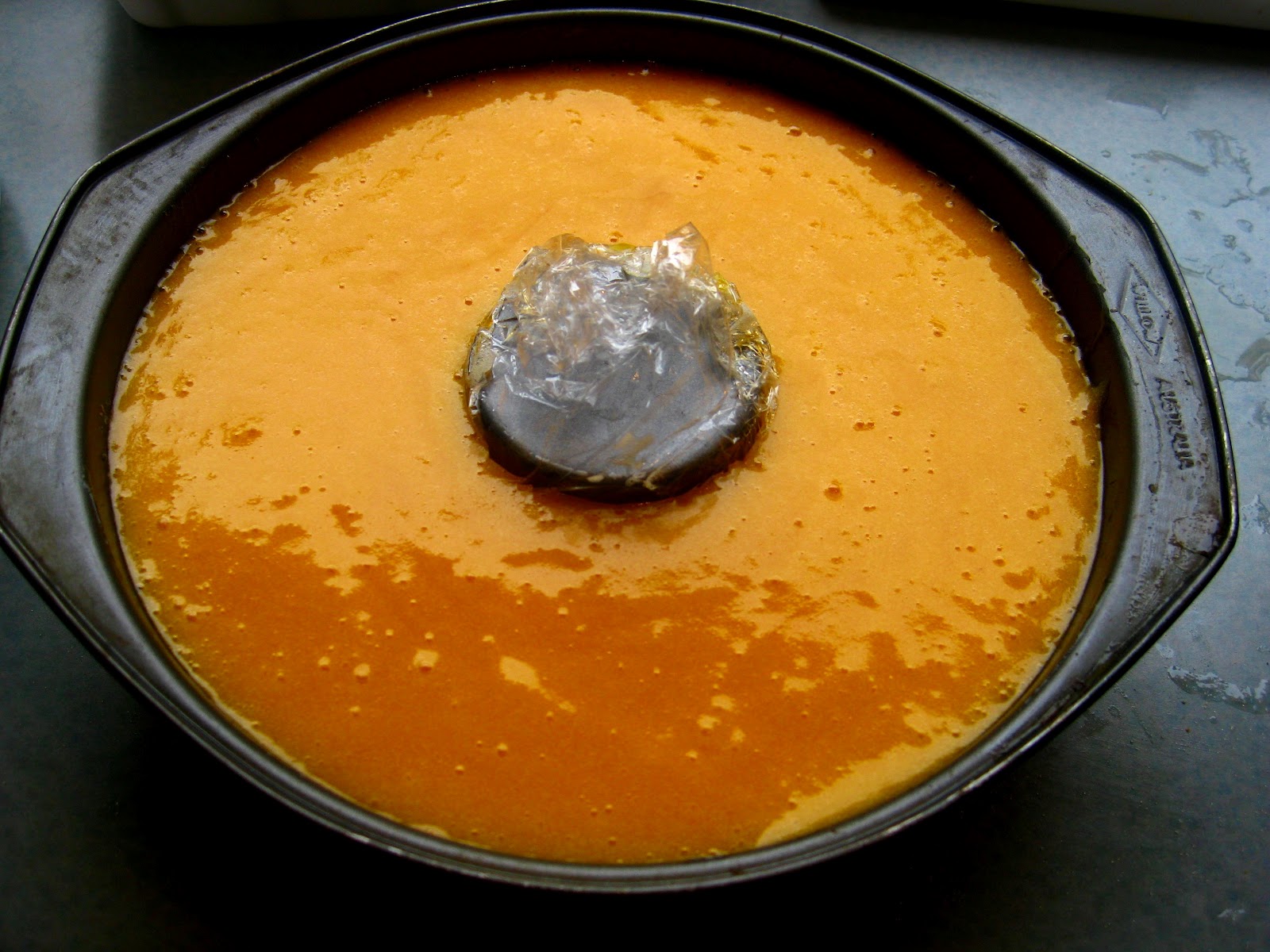

~Cover with clingwrap and leave to set in the fridge. (You could probably get away with making this in the early morning, but it's easier to do it the day, or night, before.)
~ Take it out of the fridge about an hour before you want to serve it. Just before serving, twirl the tin carefully in a sink of hot water, then put a big plate over it and upend it. With a bit of tapping on the base, it should come out cleanly.


If you like, you can fill the space in the middle with something - cream, yoghurt, chopped fresh apricots (maybe soaked in brandy and sugar for a bit), strawberries, even flowers. Or not.  (Mine is filled with the bit of clingwrap, which I forgot to take out before I took the photo.) The main point is the incredibly intense apricot flavour of the suedoise, which I think is perfect all by itself.


Sunday, February 26, 2012

The real minestrone

This weekend I had a friend coming for supper on Saturday and another for lunch on Sunday, so I thought I'd make a good hearty soup to feed them both. I had some shredded cabbage and grated carrot in the fridge, and I was pretty sure these were ingredients for minestrone. So I got out my trusty Claudia Roden bible, The Food of Italy.
        I was right. Her recipe for "minestrone alla milanese" had finely shredded white cabbage, and also carrot - though that was meant to be diced, rather than grated. But I figured it wouldn't matter. Because as Antonio Carlucci explains, in fact there's no such thing as "the real minestrone". Instead there are many versions, each one authentic for those who make it.
        I didn't want enough soup for ten people, so I halved Roden's recipe (it still made a lot). I did use Tony Gamboni's genuine pancetta (he cut it the correct thickness and then diced it up for me), and proper borlotti beans (canned, not dried - she allows for that). But her recipe has rice in it - that's probably what makes it "milanese" - and I didn't want to put rice in, because it's inclined to suck the flavour out of soup. Instead I used a handful of the pasta called biavetta, which is shaped like grains of rice. I left out the peas (because I only had frozen ones), put in more garlic, and used a can of chopped tomatoes, plus a squeeze of paste, instead of fresh ones. And rather than celery, I used lovage leaves and stalks from the garden. I reckon my soup still had every right to be called "real minestrone".

Minestrone alla Karori (guided by Claudia Roden)

120g pancetta (Italian unsmoked bacon), cut into small pieces
1 medium onion, finely chopped
2 cloves garlic, finely chopped
small bunch Italian parsley, finely chopped
2 carrots, diced (or grated)
2 tender celery sticks, thinly sliced
or  small bunch lovage, finely chopped
2 floury potatoes, peeled and diced (the new Agria on sale now are perfect)
1 can chopped Italian tomatoes
tomato paste (optional)
1 can borlotti beans, drained of their liquid
about 1/4 of a not-too-huge white cabbage, shredded
2 courgettes, diced
2 tablespoons rice-shaped pasta (biavetta or orzo - if you want really thick, filling soup, use more pasta)
To serve: small bunch basil, cut into strips, grated grana or parmesan cheese, crusty bread


In a very large saucepan or stockpot, heat the diced bacon gently until the fat runs, then add the onion and fry gently until pale golden. Add garlic and parsley and stir until the aroma rises.
Add carrots, celery, potatoes and tomatoes. Cover with plenty of water, bring to the boil, turn down to low heat and simmer gently with the lid on until the potatoes are cooked through but not mushy - about 45 minutes.
Add the drained borlotti beans and salt to taste. Add a squeeze of tomato paste if you think it's needed - the soup should taste full-bodied, but not actually tomatoey. It should be thickish, but not too thick - add a little more water if necessary. Cook for another 10 minutes.
Add the cabbage and courgettes and cook for another 15 minutes.  The veges should all be thoroughly cooked but still in distinct chunks.
Add the pasta and cook for at most 10 minutes more, until the grains of pasta are cooked enough to bite through easily but not mushy. Check seasoning.


Stir in the basil. Serve minestrone in wide bowls, with grated cheese on top (large flakes in my case, as I don't have a proper fine grater), and crusty bread on the side. At this point it's appropriate for your family or guests to come up with an enthusiastic "Mamma mia!", or other complimentary Italian phrases.


Sunday, February 19, 2012

You made my day

Definitely better now, and just easing back into food, glorious food. It's very interesting working out what I want to eat. Still quite gentle, delicate flavours and textures, it seems. At the moment I'm keen on mashed-up avocado on toast with sliced fresh tomato on top. Coffee is back, and I've tried some wine, but I don't really feel like it yet, it doesn't taste quite right.

But this week I had a wonderful comment on an earlier post ("Pollo play") that really made my day. It's exactly the kind of comment all food bloggers long for. Minette wrote, "Tried this and loved it. Thank you for creating such a delicious meal. Your blog has removed the "what shall I cook tonight" problem from my life."

Thank you so much! I'm sorry to have let you down a bit lately, but I hope to be back to full strength and come up with something else you'll like next week. Meanwhile, here's the ultimate in non-domestic-goddess food - nachos made with a can of chili beans (I'm not quite up to chili or beans yet, but it won't be long). It's also very good (and healthier) made with brown rice instead of corn chips, plus a green salad...


Friday, February 10, 2012

Yum yum

Still nothing doing, thanks to this week's relapse (see Elsewoman), but I've been enjoying showing my photos to my friends, so I thought I'd post some more of the delicious Chinese food I scoffed. I didn't get a photo of the roast pigeon at the City Hotel in Xi'an, but I did get the braised goose Guangzhou style and snow peas at the Guangzhou Restaurant.


Founded in 1935, it's the city's oldest restaurant, with original stained glass windows, upstairs off the magnificent art deco Shangxiajiu Pedestrian Streets. 

And here are fish cakes, vege dumplings and my favourite, classical shrimp dumplings. 


Three of us ate them one Saturday afternoon, along with another seven kinds of delicious morsels, washed down by lashings of green tea, over a very happy two hours at Taotaoju in the same street, one of Guangzhou's famous yum cha restaurants. It looks spectacular, with its Venetian-style chandeliers and glittering mirror walls, but it's not expensive - the whole thing came to about $26. The businessman on the cellphone is unusual only because he's standing outside the main area. At family New Year parties all over the room there were men completely engrossed with their phones and ignoring everyone else, which was a bit sad, I thought.


Monday, February 6, 2012

Nothing doing

I'm sorry, this is another holding post. My lurgy turned out to be campylobacter, and I think I know exactly how and where I caught it in Guangzhou. I'm rapidly improving, but I'm still living on the blandest and most boring diet imaginable, so nothing interesting is going on in the kitchen - unless you count the revival of half-forgotten convalescent feeding skills involving broth, puree and jelly. Here's my dinner last night - a rather beautiful bowl of pureed soup, made from carrot and potato cooked in chicken stock.


And here, just to whet your interest (by the way, everything I show you here was perfectly safe and definitely not the source of my illness) is a bowl of delicious ginger junket.


We ate this at the teaboat in the Baomo Gardens outside Guangzhou.

It cost 6 yuan (about $1.25), and buying it entitled us to watch a half-hour concert of classical Chinese music, performed against the most beautiful backdrop I've ever seen.
.
I'll try to find out how to make it. But for now, I'll have to make do with probiotic yoghurt instead.

Sunday, January 29, 2012

Too much

I had a great time in China and ate a huge range of interesting and mostly enjoyable food, but I obviously overdid it somewhere because this week I came down with a very nasty stomach bug. I've only just started to feel slightly better so hope to post properly later this week.

Friday, January 6, 2012

Pollo play

Not having cooked many proper dinners since before Christmas, I was very happy to have friends coming for dinner this week. As I'm off to China on Monday, and want to leave at least a scrap of room in the freezer for my housesitter, I decided it would be a good chance to use what I had instead of going shopping. When free range chickens were on special a while ago I cut two up and froze the pieces. But I needed a recipe that involved some kind of marinade, because even when it's fresh, chicken can taste a bit boring.
       
What I came up with was a combination of two recipes from my oldest Italian cookbook, Ada Boni's venerable Talisman, organised so as not to use any flour (one of my friends doesn't eat gluten).
         The marinade was from her Pollo frito alla Fiorentina, Florentine fried chicken with lemon and parsley. But the cooking was from her Pollo alla cacciatora, Hunter's chicken, which also uses parsley, as well as onion, garlic , celery and white wine - but no tomatoes, unlike most other versions of hunter's chicken I've seen.

Pollo alla Karori (with homage to Ada Boni)

Chicken pieces, trimmed of loose fatty bits and loose bits of skin (4 drumsticks and 4 thighs, all with skin on, is a good combination for 4 people)

For the marinade:
2 Tbsp olive oil
4 Tbsp lemon juice (I used the salty juice from a jar of my preserved lemons)
salt and pepper (I didn't need any more salt)
2 tsp finely chopped Italian flat-leaved parsley
Mix well and cover the chicken pieces with this marinade. Leave for at least 2 hours before cooking.

For the sauce and cooking:
Olive oil for frying
1 small onion, finely chopped
2 cloves garlic, finely chopped
3 tender sticks celery, or a bunch of lovage leaves and stalks (this gives the flavour without any stringy bits)
2-3 sprigs flat-leaved parsley
salt and pepper
150 ml dry white wine

- Set oven to 180C, fan forced, or 190 without fan. Take chicken pieces out of marinade, shake well and pat them a little with paper towel to dry them slightly. Then, as Ada puts it, "Place in frying pan some olive oil" - or better, use a pan that can also go in the oven.  Fry the pieces in two batches until they are thoroughly browned on all sides. Remove and keep warm.
- Add a little more oil and gently fry the onion, garlic, celery and parsley until soft. Add white wine. Cook for a few minutes to reduce a little, then add the remaining marinade. Check seasoning and add more salt and pepper if necessary.
- Add chicken pieces, put pan in oven uncovered, and bake until chicken is tender and cooked right through, but not dried out - about 35-45 minutes, depending on your oven and how large the pieces are. Baste chicken pieces with the sauce twice during cooking.
- Remove pieces and keep warm while you degrease the sauce - I carefully place a double-folded piece of thick paper towel on the surface to absorb the excess fat, doing it twice if necessary. If there is too much sauce or it seems too thin, reduce it a little on the hob. Check seasoning again


You can either put the chicken pieces back in the sauce, or serve the sauce separately, along with whatever kind of potatoes you prefer. I baked small red-skinned golden-hearted potatoes in a separate roasting tin on a lower shelf while the chicken was cooking - all they needed was a  little oil and salt. We had pieces of preserved lemon with this, and a green salad, with a pinot gris. The light, summery celery/parsley/lemon flavours were a great success (she said modestly). Look for the next post (China!) in late January.